How to Create Cinematic AI Fight Scenes with Seedance 2.5
Seedance 2.5 requires structured production-style prompting for cinematic AI fight scenes, combining character sheets, environment references, and detailed choreography timelines rather than simple text descriptions. This workflow emphasizes visual consistency through ChatGPT-generated reference sheets and explicit control over camera movement, physics, lighting, and action sequencing.
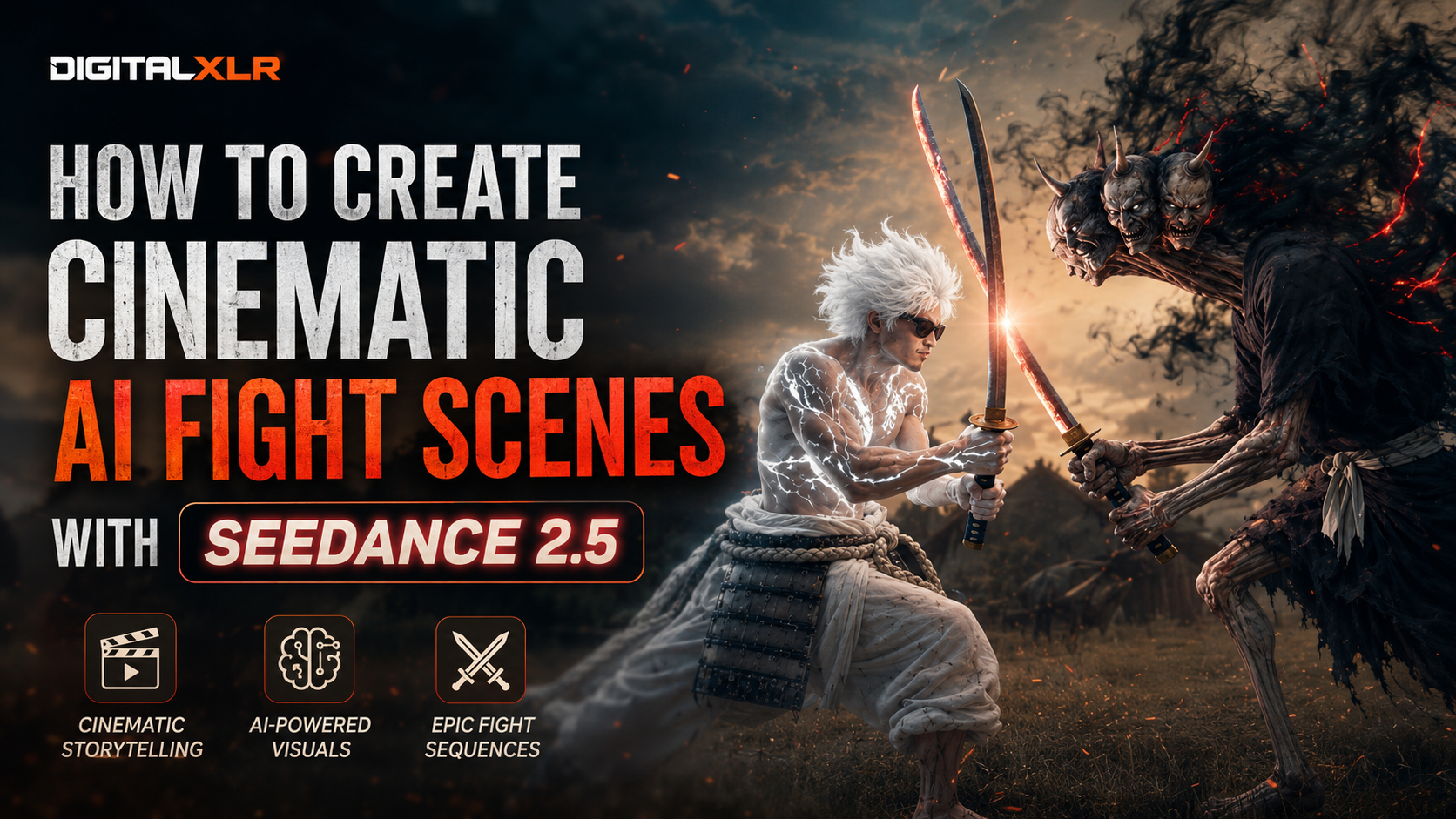
Creating a cinematic AI fight scene with Seedance 2.5 is not about writing “two warriors fight with swords” and hoping the model figures out the rest. For complex action, you need to approach the prompt like a production brief. You define the characters, environment, movement system, choreography, camera behavior, lighting, visual style, physics, and sound, then give Seedance enough structure to keep all of those elements working together. Current Seedance 2.5 prompting guidance similarly emphasizes clearly assigning reference roles, defining the scene and action, and using structured timelines when precise control is important.
This workflow is designed for creating the kind of high-speed, cinematic sword fight where the characters move faster than the camera can comfortably track, physical impacts damage the environment, visual effects have their own identity, and the entire sequence feels like one continuous action scene rather than a collection of unrelated AI shots.
Preparation
Before generating the actual fight, prepare the visual references first. The two most important things are the character sheet and the environment sheet. The character sheet establishes exactly who is fighting, while the environment sheet establishes exactly where the fight takes place. Doing this first gives Seedance a visual foundation before we introduce complicated movement and choreography.
The goal is consistency. When you generate fast action, there are many opportunities for a model to drift. A face can change, clothing can change, weapons can change, or the environment can suddenly become a completely different location. By preparing the references first, you are giving the model a much stronger visual anchor.
Generate the Character Sheet with ChatGPT

For the character sheet, we use ChatGPT with the original photograph as the reference. This is especially important when the subject is a real person because Seedance has strict likeness protection. Rather than assuming the original photo will be reproduced exactly in the final video, we first create a dedicated character reference that represents the person in a controlled visual format.
The character sheet uses three views in a single 16:9 composition: a full-body front view, a medium portrait view, and a full-body back view. This gives us facial information, body proportions, clothing information, hairstyle information, and a clearer overall silhouette. Seedance's own prompting guidance also recommends assigning explicit roles to reference assets rather than simply uploading images without explaining what each reference should control.
Use the following prompt in ChatGPT together with the person's photograph:
Create a 16:9 black-and-white fashion sketch illustration of the person from the photo reference. Three views side by side: full body front view, medium portrait view, and full body back view. Realistic body proportion. Use only monochrome tones: black, white, graphite grey, charcoal grey, and soft pencil shading. No color. No watercolor color fill. No blue, grey-blue, skin tone, or tinted palette. Style: loose expressive pencil lines, high-detail facial shading, fashion design sketch aesthetic, clean white paper background, strong negative space. Face: preserve the original facial structure, eye shape, nose, lips, jawline, hairstyle, and all distinguishing features. Skin: render only with light graphite pencil shading and minimal hatching. Hair: use sharp dark ink lines and deep charcoal shading. Clothing and body: sketch clearly with elegant fashion proportions, natural pose, and clean linework. Final image must look like a professional black-and-white fashion concept sketch on white paper.
Once the sheet is generated, treat it as the master character reference. Do not keep changing the character design every time you generate a new clip. The purpose of this step is to establish a stable visual identity that can be reused throughout the entire sequence.
For our example, Adam's reference establishes pale white wind-whipped hair, sunglasses, a bare muscular torso with glowing white dragon-tattoo lines, white electrical energy, samurai-style clothing around the waist, and twin katana. Asura has a completely different visual identity, including an elongated sinew neck, multiple screaming demon faces, horns, a tattered black robe, skeletal clawed hands, twin curved blades, and taloned feet.
Generate the Environment Sheet
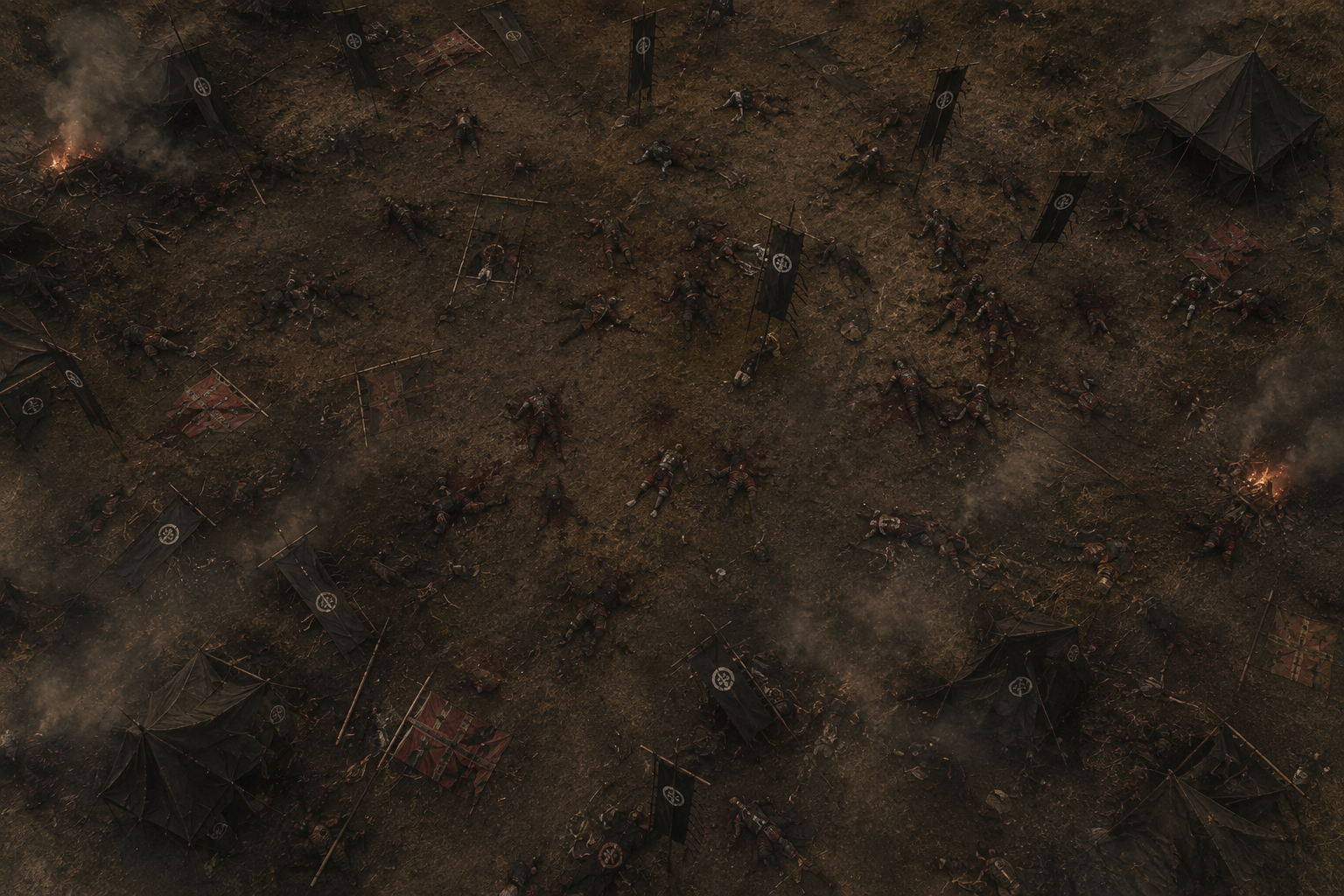
After the character sheet, create an environment reference. For this example, the fight takes place on a ruined steppe battlefield at dusk, with scattered corpses, broken war banners, torn tents, packed dirt, dead grass, drifting ash, and distant mountains.
The environment reference gives Seedance a consistent location to work with. This matters because the battlefield is not just a backdrop. It becomes part of the fight. When the fighters move at extreme speed, they interact with the ground. When weapons collide, debris moves. When a banner is cut down, it stays down. When a tent is destroyed, it should remain damaged.
This kind of continuity is important for making the sequence feel like one physical location. Seedance 2.5 prompting guidance also recommends explicitly defining scene and environment information rather than assuming the model will maintain every location detail automatically.
Build the Seedance 2.5 Prompt
Now we can build the actual Seedance prompt. This is where we stop thinking in terms of a simple description and start thinking like a director.
Instead of writing “create an epic sword fight,” define the technical settings, references, identity rules, environment, movement system, combat rules, choreography, camera, physics, audio, continuity, and negative prompt. Current Seedance 2.5 prompting references recommend explicitly identifying subjects, actions, environments, camera direction, visual treatment, and audio rather than relying on vague descriptions.
The important difference is that you are not only telling Seedance what the fight looks like. You are defining how the fight behaves.
Assign the References
Inside the prompt, clearly state what each reference image represents. For example, Image 2 can be the Adam character master reference, while Image 3 can be the Asura character master reference. If Image 1 is the previous clip's last frame, explicitly state that it exists for pose and environment continuity only.
This matters because a reference should have a job. Seedance's own prompting documentation specifically discusses assigning separate, explicit roles to images, video, audio, and other assets instead of leaving the model to guess what each asset is supposed to control.
Once the roles are established, lock the character identity. Tell Seedance to preserve the face, hairstyle, body proportions, costume, accessories, and weapons. In our example, the prompt explicitly prevents face changes, costume changes, body-proportion changes, weapon replacement, and character fusion.
Create a Keyword to Trigger a Specific Movement
Now we get to the technique that makes this workflow particularly useful for extreme-speed combat.
Instead of describing the same complicated movement every time, define a keyword and give that keyword a precise meaning.
For this fight, the keyword is BURST.
BURST means extreme physical acceleration. It does not mean teleportation. The fighter physically travels across the distance at extreme speed, leaves a brief translucent afterimage, can temporarily outrun the camera, and is then reacquired through a whip-pan.
Once BURST has been defined, you can trigger that behavior simply by using the word inside the choreography.
“Adam BURSTS forward” tells Seedance that Adam is using the predefined acceleration mechanic. “Asura BURSTS to intercept” triggers the same fundamental movement system but with Asura's own visual effects. “Adam BURSTS upward” changes the direction while preserving the same underlying behavior.
This is essentially creating your own vocabulary inside the prompt. Instead of repeatedly explaining the entire movement mechanic, you establish it once and then use the keyword as a trigger throughout the scene.
Give Each Fighter a Unique Burst Signature
The BURST behavior is shared, but the visual result should be different for each character.
Adam uses white electrical energy. His body and blades carry crackling white electricity, and each burst creates branching white lightning and a translucent white afterimage.
Asura uses black mist and red electricity. His skeletal limbs and blades are surrounded by dense black shadow-mist, while crimson electricity pulses through his exposed sinew and horns. His bursts produce black mist, red lightning, and scorched marks on the ground.
This gives the audience a visual way to identify the fighters even when the movement becomes too fast to follow frame by frame.
Choreograph the Fight with Timecodes
Once the movement keyword is established, build the actual fight as a timeline.
Do not ask Seedance to invent ten seconds of combat from a single sentence. Define what happens at specific points in the sequence. Seedance 2.5 guidance recommends using explicit timelines and shot or beat breakdowns when you need stronger control over a longer or more complicated generation.
Our sequence starts directly inside the action. At 00:00–00:01, Adam BURSTS forward while Asura reacts with his own burst, and their blades collide almost immediately. White lightning, black-red mist, dust, and debris explode from the impact. At 00:01–00:02, Adam BURSTS to Asura's flank, the camera briefly loses him, and a whip-pan reacquires him during a diagonal slash. At 00:02–00:03, Adam BURSTS upward while Asura intercepts him in mid-air. At 00:03–00:04, Adam is thrown backward but converts the momentum into another BURST. At 00:04–00:05, both fighters BURST directly toward each other and collide at maximum speed. The sequence continues through aerial attacks, burst dodges, shockwaves, rapid repositioning, and additional collisions until the final impact at the end of the clip.
The important part is that every time block has a purpose. You are creating an actual choreography rather than asking the model to improvise the entire sequence.
Make the Camera React to the Speed
The camera needs its own logic.
One of the reasons high-speed AI fights can look artificial is that the camera tracks everything too perfectly. If the fighter can move faster than a human eye could follow, but the camera somehow remains perfectly locked onto the action, the movement loses some of its physical credibility.
In our prompt, the fighters can outrun the camera during a BURST. The camera briefly loses them and then whip-pans to reacquire them. The scene uses pursuit shots, low-angle tracking, aggressive lateral movement, rapid whip-pans, close weapon tracking, short impact orbits, ground-level shots, and fast push-ins.
The camera is allowed to struggle, but it should not become completely disorienting. The audience still needs to understand where the fighters are relative to one another.
Keep the Physics Grounded
Extreme speed does not mean abandoning physics.
The fighters can move at impossible velocities while their movement still obeys momentum, gravity, inertia, weapon weight, and collision physics. The prompt explicitly establishes those requirements.
Adam's hair and clothing should react to his acceleration. Asura's tattered robe should react to his movement. Weapons should have believable weight. Dirt and debris should move according to the impact. The energy effects should interact with the environment rather than looking like flat visual overlays.
The goal is not to make the speed realistic. The goal is to make the movement physically coherent despite the impossible speed.
Lock the Visual Style
After defining the fight itself, lock the visual style.
This is essential because the same choreography can produce completely different-looking footage depending on how the model interprets the scene. For this workflow, we want an ultra-premium live-action, photorealistic, AAA Hollywood blockbuster look rather than animation, cartoon rendering, or game graphics.
Use this style direction:
Ultra-premium live-action photorealistic AAA Hollywood blockbuster, realistic human/creature actors, practical-costume realism, physically accurate materials, cinematic HDR, natural skin and fabric detail, realistic atmospheric effects, high-end action cinematography.
This is the visual direction that needs to remain consistent throughout the shot.
The negative prompt should reinforce that decision by explicitly rejecting anime, cartoon, cel shading, video-game graphics, plastic skin, artificial faces, flat lighting, neon cartoon VFX, flat smoke, and 2D energy effects.
The combination of a clear positive style description and explicit exclusions gives the model a much narrower visual target.
Control Lighting and Atmosphere
The visual style becomes stronger when the lighting is also defined.
For this fight, the environment is set during dusk, with cold ambient twilight mixed with white electrical illumination from Adam and deep crimson-black atmospheric energy from Asura. The battlefield is filled with drifting smoke and ash.
This keeps the lighting connected to the characters and the environment instead of allowing every frame to invent a different lighting setup.
Make Destruction Accumulate
Another important part of cinematic combat is making the environment remember what happened.
If a banner is destroyed during the fight, it remains destroyed. If a tent is damaged, that damage carries forward. If the ground is gouged by a burst, the mark remains. The prompt explicitly requires progressive damage rather than resetting the environment after every action.
This small detail makes a huge difference because it tells the viewer that the characters are actually interacting with a persistent physical environment.
Use Short Slow-Motion Moments
The sequence should remain fast.
Slow motion should only appear at the biggest collisions, and even then it should be extremely brief. The original choreography specifies approximately 0.15–0.25 seconds of slow motion at the two heaviest impacts before immediately snapping back to full speed.
That contrast makes the impacts easier to read without destroying the feeling of speed.
The prompt defines heavy sword impacts, metallic clashes, bass shockwaves, sharp cracks of displaced air during bursts, dirt impacts, cloth tearing, sword whooshes, footsteps, sliding friction, electrical sounds, red-lightning cracks, supernatural rumbling, atmospheric wind, and falling embers.
The important idea is synchronization. A BURST should sound like acceleration. A sword collision should feel heavy. A shockwave should have physical impact. Music should support the fight rather than hiding the sound design.
The Complete Seedance 2.5 Fight Prompt
Once the preparation, movement system, choreography, camera, style, physics, and audio have been defined, combine them into one complete prompt.
The result should read like a production blueprint. It begins with the technical configuration, then defines the references and identity lock, establishes the BURST mechanic, defines the visual signatures of both fighters, establishes the environment and combat rules, provides the second-by-second choreography, and finishes with camera choreography, physics, audio, continuity, and the negative prompt.
That structure is consistent with current Seedance 2.5 prompting guidance, which emphasizes clearly defined subjects, actions, environments, visual treatment, camera direction, sound, reference roles, and explicit timelines for more controlled generations.
The complete fight prompt used in this tutorial is:
SEEDANCE 2.5 — ADAM (WHITE LIGHTNING) VS Asura (BLACK-RED DEMON) — HYPERSONIC ESCALATION
[MODEL] Seedance 2.5
[DURATION] EXACTLY 10 SECONDS
[FORMAT] 9:16 vertical cinematic
[FRAME RATE] 24 FPS
[STYLE] Ultra-premium live-action photorealistic AAA Hollywood blockbuster, realistic human/creature actors, practical-costume realism, physically accurate materials, cinematic HDR, natural skin and fabric detail, realistic atmospheric effects, high-end action cinematography.
[CAMERA] Dynamic handheld + stabilized pursuit camera + low-angle tracking + rapid orbiting camera + whip-pan reacquisition during speed bursts. No artificial game-camera movement.
[LIGHTING] Dusk battlefield twilight, dramatic drifting smoke and ash, cold ambient dusk light mixed with white electrical illumination and deep crimson-black mist.
REFERENCE & IDENTITY LOCK
Image 1 = last frame of the previous clip, used for pose and environment continuity only.
Image 2 = ADAM CHARACTER MASTER REFERENCE, transformed state. Preserve 100% identity lock: pale white wind-whipped hair, sunglasses, bare muscular torso with glowing white dragon-tattoo lines, crackling white-electrical energy, samurai hakama/armor wrap at waist, twin katana. Do NOT redesign.
Image 3 = Asura CHARACTER MASTER REFERENCE, transformed state. Preserve exact character design: elongated sinew neck, multiple screaming demon faces surrounding the original aged face, jutting horns, tattered black robe, skeletal clawed hands, twin curved blades, taloned bird-like feet. Do NOT redesign.
IDENTITY RULE: both characters must remain visually consistent throughout. No face changes, no costume changes, no body-proportion changes, no weapon replacement, no character fusion.
ENERGY SYSTEM — HYPERSONIC BURST MECHANIC
Both fighters possess bursts of EXTREME PHYSICAL ACCELERATION beyond normal combat speed. NORMAL exchange → strike approaches → LAST-INSTANT BURST → fighter physically rockets across the distance (NO teleportation, always a physical traversal) → brief translucent afterimage trails the burst → camera is briefly outrun and whip-pans hard to reacquire → impact or repositioning completes → speed snaps back to normal.
ADAM — WHITE LIGHTNING AURA
Crackling white-electrical aura across skin and blades. Every burst detonates as violent branching white lightning, a sharp crack of displaced air, and a fragmented translucent white afterimage lingering 0.15–0.2 seconds. Bright, sharp, elegant — never smoky or dark.
Asura — BLACK MIST + RED ELECTRICAL DEMON AURA
Dense black shadow-mist swirling around his skeletal limbs and twin blades, mixed with veins of crimson-red electricity pulsing through exposed sinew and horns. Every burst detonates as a violent plume of black mist with a branching red-lightning flash cutting through it, his taloned feet leaving scorched drag-marks. Dark, dangerous, unnatural — never glowing like ordinary fire.
ENVIRONMENT
The same ruined steppe battlefield from Image 1 and Image 4 — scattered corpses, broken war banners, torn tents, drifting ash, packed dirt and dead grass, distant mountains at dusk. Every burst and impact physically affects the environment: dirt explodes and gouges beneath burst-offs, banners rip further, debris scatters violently, no environmental reset between shots.
COMBAT RULES
DIRECT COMBAT FROM FRAME 1, already at hypersonic intensity. No walking introduction, no posing, no dialogue, no staring, no slow buildup, no opening title, no ending shot, no final pose. The entire 10 seconds is one uninterrupted, escalating high-speed fight built around repeated acceleration bursts rather than steady-speed swordplay. Realistic footwork, aggressive dodging, aerial movement, sliding attacks, sudden direction changes, realistic weight and inertia — but punctuated by explosive full-body speed bursts that outrun the camera. Both characters continuously attack, defend, evade, reposition — never idle more than a fraction of a second. Minimal impact slow motion only 0.15–0.25 seconds at the two heaviest collisions, then immediately snap back to full or hypersonic speed.
SECOND-BY-SECOND CHOREOGRAPHY
00:00–00:01
Start already inside the action at full intensity. Adam BURSTS forward — CRACK! — a violent detonation of white lightning and displaced dust, closing the distance in a blink, translucent afterimage trailing him. Asura reacts with his own burst, black mist erupting off his frame, red electricity flashing through his ribs. Both blades meet mid-burst. IMPACT: white lightning and black-red mist explode outward, dirt craters beneath both.
00:01–00:02
Adam BURSTS again, breaking off the clash and reappearing at Asura's flank — camera briefly loses him, then WHIP-PANS to reacquire as he lands a diagonal slash. Asura counters with his own burst-step, black mist smearing behind him as he ducks under the blade at inhuman speed, countering with a scissor-slash. A banner pole is severed in the wake of the exchange, wood splintering.
00:02–00:03
Mid-air, Adam BURSTS upward into a rapid double-blade descending strike, white lightning trailing in a bright arc. Asura BURSTS to intercept, both blades crossed overhead. COLLISION: white lightning against black mist and crimson sparks, a full-frame flash. Shockwave scatters debris and ash. Camera whip-pans hard to keep pace, then circles both fighters at close range.
00:03–00:04
Asura's demon strength overpowers the clash, throwing Adam backward. Adam BURSTS out of the throw mid-air, converting it into a horizontal high-speed dash, white lightning becoming a dense streaking trail across the frame. Asura BURSTS in pursuit, black mist and red arcs tearing a scorched line across the dirt behind him.
00:04–00:05
EXTREME SPEED COLLISION. Both fighters BURST directly at each other simultaneously — for a fraction of a second the frame is nearly solid white-lightning and black-red mist, camera whip-pans twice failing to track either fighter — then they reappear mid-clash, blades locked, tearing into the ground and a nearby fallen tent. IMPACT: dust, torn fabric, and dual-colored energy detonate outward. Camera drops extremely low between them.
00:05–00:06
Adam BURSTS behind Asura, unleashing two extremely fast sword strikes in the same instant, white afterimages layering behind each strike. Asura deflects the first, then BURST-dodges the second with an unnatural neck-twist, red electricity cracking through his sinew as mist trails his motion. Camera performs a rapid orbit, straining to keep both fighters in frame.
00:06–00:07
Asura releases a shrieking demonic shockwave-burst, black mist and red lightning detonating outward from his multiple faces simultaneously. Adam BURSTS forward directly through it, katana crossed, white lightning tearing a bright corridor through the black-red wave. A nearby broken tent collapses further under the combined pressure.
00:07–00:08
Adam BURSTS into a high-speed aerial slash, arriving faster than the eye can track — camera catches only the afterimage, then whip-pans up to find him mid-strike. Asura BURSTS to intercept, blades meeting overhead. HEAVY IMPACT: brief 0.2-second slow motion as white and black-red energy spiral violently around the collision point, then immediately snap to full hypersonic speed. Camera shakes hard from the shockwave.
00:08–00:09
Both fighters are thrown apart by the impact, then instantly BURST back toward each other before either fully stops moving — twin trails of white lightning and black-red mist converging across the battlefield. Camera pushes forward fast between them, struggling to hold pace with both accelerations. The air itself seems to crack from the combined velocity.
00:09–00:10
FINAL BURST COLLISION — but NOT the ending. Both fighters BURST simultaneously at maximum hypersonic speed, weapons meeting at center frame in a massive white-and-black-red energy shockwave. Dirt fractures outward in a violent radial pattern, torn banners and debris hurled into the air, dust filling the background, camera whip-panning one last time trying and failing to fully catch the collision. CUT DURING ACTIVE COMBAT — no final pose, no victory stance, no character looking at camera, no freeze frame, no fade-out.
CAMERA CHOREOGRAPHY
Low-angle pursuit shots, aggressive lateral tracking, rapid whip-pans specifically timed to burst-outs (camera outrun, then snap-reacquire), close weapon tracking, short orbit around impacts, ground-level camera during slides, fast push-in during energy collisions, natural handheld vibration during heavy impacts, subtle motion blur during extreme acceleration, occasional foreground debris passing in front of lens. Camera must never become disorienting; maintain clear spatial continuity between the two fighters even when briefly "losing" them during bursts. No teleportation logic — every burst is a physical traversal, not a cut. No impossible drone movement, no excessive slow motion beyond the two specified impact beats.
REALISTIC PHYSICS & VFX
All movement obeys realistic momentum, gravity, inertia, and collision physics even during bursts — velocity is extreme but motion remains physically continuous. Adam's hair and loose robe fabric whip violently during dashes and bursts. Asura's tattered robe and screaming faces react naturally to movement and impacts. Weapons carry realistic weight and momentum. Dirt and debris follow realistic trajectories. White lightning and black-red mist interact with the environment and each other but never as flat 2D effects, cartoon particles, or artificial glowing outlines.
AUDIO DESIGN
Cinematic AAA action soundscape: heavy sword impacts, metallic weapon clashes, deep bass shockwaves, sharp cracks of displaced air on each burst, dirt cracking, cloth tearing, debris impacts, fast sword whooshes, footsteps and sliding friction, crackling white-electrical buzz, violent red-lightning cracks, deep supernatural black-mist rumble, atmospheric wind, distant embers falling. Every burst and every visible impact has synchronized physical sound. Music: dark cinematic hybrid score with deep percussion, taiko-style impacts, rising tension escalating with each burst — never overpowering physical combat sounds. No dialogue, no voice-over, no subtitles.
VISUAL CONTINUITY RULES
Maintain exact character identity, costume, and weapon designs throughout, even mid-burst. Maintain consistent environment geography from Image 1 and Image 4. Damage accumulates progressively; previously destroyed objects remain destroyed. Energy and burst intensity escalate across the 10 seconds but stay visually consistent. No teleportation, no duplicated limbs, no extra weapons, no accidental character fusion, no sudden costume transformation mid-fight.
NEGATIVE PROMPT
anime, cartoon, cel shading, video game graphics, plastic skin, artificial faces, beauty filter, identity drift, character redesign, costume redesign, random accessories, body deformation, incorrect proportions, extra limbs, extra fingers, missing fingers, duplicated weapons, floating weapons, teleportation, unrealistic physics, weightless movement, robotic movement, stiff choreography, slow combat, excessive slow motion, frozen pose, standing idle, walking introduction, opening sequence, ending sequence, victory pose, final pose, looking at camera, dialogue, subtitles, text, logos, watermark, UI, health bar, fake environment, flat lighting, oversaturated colors, neon cartoon VFX, flat smoke, 2D energy effects, unrealistic explosions, random camera teleportation, impossible camera movement, environment reset, inconsistent destruction, inconsistent lighting, face morphing, changing hairstyle, changing clothing, changing weapon, character fusion, blurry face, motion artifacts, flickering, rubber limbs, unnatural anatomy, mountain fortress, stone courtyard, snow, fur mantle armor.
FINAL DIRECTIVE
Create a seamless, hypersonic, physically grounded, live-action cinematic fight between Adam's white-lightning form and Asura's black-and-red demon form, on the same ruined steppe battlefield from Image 1/Image 4. Preserve both reference designs with absolute consistency. The fight is built around repeated full-body acceleration bursts that outrun the camera and snap back via whip-pan, escalating in intensity from the first frame until the clip cuts mid-collision, with white lightning versus black mist and red electricity, realistic destruction after every major impact, cinematic camera choreography, synchronized sound design, no ending pose.
The important thing is not simply the length of the prompt. Every section has a job.
The character references establish who is fighting.
The environment reference establishes where the fight is happening.
The BURST keyword establishes a repeatable movement system.
The choreography establishes what happens and when.
The camera instructions establish how the viewer experiences the speed.
The physics instructions establish how the world reacts.
The style establishes the visual language.
The negative prompt establishes the boundaries.
Final Workflow
The complete process is simple once the system is established. Start with the original photograph and use ChatGPT to create the three-view character sheet. Create the environment reference. Bring those references into Seedance and explicitly assign their roles. Build the fight prompt around the characters, environment, and movement system. Define a keyword such as BURST for any complex action behavior you want to reuse. Break the fight into timed choreography. Add the camera behavior, physics, lighting, audio, continuity rules, and negative prompt. Then generate the video.
The key is to stop thinking of an AI video prompt as a description and start thinking of it as a production system.
You are not telling Seedance, “make a cool fight.”
You are telling it who is fighting, where they are fighting, how they move, how the camera reacts, how the environment responds, what the footage should look like, and what the model must avoid.
That is what allows you to create a cinematic AI fight scene that feels deliberately choreographed instead of randomly generated.
Conclusion
The most important lesson is simple: don't prompt the result; design the system that produces the result.
Prepare the character before generating the video. Prepare the environment before starting the choreography. Define your movement keywords before using them. Break complex combat into timed actions. Let the camera react to extreme speed. Make the physics and destruction persistent. Then lock the visual style and aggressively exclude unwanted rendering styles.
For this particular fight, the BURST mechanic is the key. Once that behavior is defined, the same keyword can repeatedly trigger extreme acceleration while each character retains a unique visual signature.
That combination of structured references, reusable movement keywords, timed choreography, cinematic camera behavior, physical continuity, and strong style control is what turns Seedance 2.5 from a tool that generates action into a tool you can actually direct.
Frequently Asked Questions (FAQ)
Q: Why do I need character sheets before generating fight scenes in Seedance 2.5?
Character sheets provide visual anchors that prevent drift during fast action sequences—keeping faces, clothing, weapons, and proportions consistent across multiple AI-generated shots when the model struggles with rapid movement.
Q: How do I create character reference sheets for Seedance 2.5?
Use ChatGPT with a photograph to generate a 16:9 black-and-white fashion sketch showing three views: full-body front, medium portrait, and full-body back, with explicit instructions to preserve facial structure and distinguishing features.
Q: What makes a good Seedance 2.5 prompt for fight scenes?
Treat it like a production brief: define characters, environment, movement systems, choreography, camera behavior, lighting, visual style, physics, and sound—using structured timelines when precise control matters.
Q: Does Seedance 2.5 have likeness protection for real people?
Yes, Seedance has strict likeness protection, so creating a stylized character reference sheet through ChatGPT first provides better control than relying on direct photo reproduction in the final video.